The best first drone is not necessarily the cheapest model or the aircraft with the longest specification list. It is the drone that matches the beginner’s real purpose, flying environment, camera expectations, legal requirements, and tolerance for repair or replacement costs.
A person who wants short automated travel clips needs a different aircraft from someone learning aerial photography, recording property exteriors, or planning to grow into professional work. Buying too little can lead to poor footage and rapid replacement. Buying too much can make every practice flight unnecessarily stressful.
This guide compares current beginner-friendly examples using official manufacturer specifications. The models are not presented as personally tested, and the recommendations are not an exhaustive ranking of every brand. Prices are intentionally excluded because regional availability, controller options, bundles, taxes, and promotions change frequently.
Best suited to simple automated clips, personal tracking, palm operation, and creators who value convenience more than RAW photography or a traditional three-axis camera platform.
Combines full-coverage propeller guards, a three-axis gimbal, RAW photography, a 1/1.3-inch camera, and conventional remote-controller operation.
A strong fit for beginners who want a lightweight camera drone with omnidirectional sensing, RAW files, vertical capture, and room to develop more advanced skills.
An easy selfie drone, a protected vlog drone, a compact photography drone, and a larger dual-camera aircraft solve different problems. Choose the category first and the exact model second.
What a beginner actually needs
Satellite positioning is extremely useful for an outdoor camera drone because it supports position hold, home-point recording, return functions, and navigation. It should not, however, be described as mandatory for every beginner.
A small manually controlled drone can teach orientation and gentle stick inputs in a protected indoor environment. A beginner whose goal is aerial photography may be better served by learning directly on a properly configured GNSS-equipped camera drone in a large, legal, obstacle-free area.
The most important feature is not automation by itself. It is whether the pilot understands what the aircraft will do after low battery, signal loss, positioning problems, an incorrect home point, or activation of Return to Home.
Current beginner-friendly examples
DJI Neo 2
Easiest personal-content optionThe Neo 2 is designed around convenient personal filming rather than traditional aerial photography. It can be operated through supported automatic modes, mobile-device control, a compatible remote controller, motion control, or goggles, depending on the configuration.
Its compact body includes propeller protection and an omnidirectional monocular vision system supported by forward LiDAR and a downward infrared sensor. That assistance may reduce some collision risks, but it remains dependent on lighting, surface detail, speed, reflectivity, and the operating mode.
The camera records 12-megapixel JPEG photographs and supports horizontal 4K video up to 60 fps in ordinary supported configurations. It uses a two-axis mechanical gimbal together with electronic stabilization rather than the three-axis gimbal found on more photography-focused models.
DJI Flip
Best protected first camera droneThe Flip occupies a useful middle position between a personal selfie drone and a conventional folding camera drone. Its foldable full-coverage propeller guards provide additional physical separation around the propellers, while its camera offers RAW photography, a three-axis gimbal, and more advanced recording options.
The 1/1.3-inch sensor records 12- or 48-megapixel photographs and 4K video. The aircraft also supports automated capture features and subject tracking.
Its sensing system should not be confused with the omnidirectional obstacle sensing of a Mini 4 Pro. The Flip uses a forward 3D infrared sensing system and downward positioning sensors. Sideways, backward, thin, reflective, or poorly lit obstacles may remain difficult or impossible to detect.
DJI Mini 4 Pro
Best balanced compact choiceThe Mini 4 Pro remains a well-balanced choice for a beginner who wants a traditional folding camera drone with a lightweight standard configuration, broad obstacle-sensing coverage, RAW photography, stabilized video, and intelligent flight features.
Its camera uses a 1/1.3-inch CMOS sensor, not a half-inch sensor. It records 12- and 48-megapixel photographs, offers JPEG and DNG files, and uses a three-axis mechanical gimbal.
The omnidirectional binocular vision system provides more complete coverage than the Flip’s forward and downward system. It still cannot detect every wire, branch, reflective surface, textureless wall, or object in poor lighting.
With the standard battery, DJI lists a maximum flight time of 34 minutes. The optional Plus battery increases published endurance but also increases aircraft weight beyond 249 grams.
DJI Mini 5 Pro
Best premium compact optionWhere officially sold, the Mini 5 Pro is a more advanced compact option for a beginner who already knows that image quality matters. Its one-inch 50-megapixel camera, omnidirectional vision system, forward LiDAR, internal storage, and wider gimbal movement provide capabilities beyond an ordinary starter aircraft.
DJI lists its nominal takeoff weight as 249.9 grams with a possible product variation of approximately plus or minus four grams. This detail matters in countries where 250 grams is a regulatory threshold. The physical aircraft, battery, accessories, guards, lights, and payload must be considered rather than relying only on the product name.
DJI publishes a 36-minute maximum flight time with the standard battery, but its own more representative “typical flight time” test lists approximately 21 minutes. The difference illustrates why beginners should never plan a flight around the maximum laboratory figure.
DJI Air 3S
Best larger step-up optionThe Air 3S is better understood as a step-up aircraft than as the default first purchase. Its 724-gram airframe, dual-camera system, longer published endurance, 42 GB of internal storage, omnidirectional sensing, and forward LiDAR provide substantial capability, but also increase cost, transport size, legal obligations, and the consequences of a mistake.
The wide camera uses a one-inch 50-megapixel sensor, while the 70 mm-equivalent medium telephoto camera uses a 1/1.3-inch 48-megapixel sensor. The telephoto view can help isolate subjects without flying as close, although it also magnifies vibration and requires careful focus and route planning.
DJI lists a 45-minute maximum flight time and 12 m/s maximum wind resistance under its stated test conditions. These figures are capabilities, not targets or guaranteed operating time.
A model shown on a regional manufacturer page may not be officially sold, supported, or approved in every market. Check the manufacturer’s current local store, warranty policy, Remote ID documentation, frequency rules, and authorized retailers before purchasing.
Beginner-drone comparison
| Model | Best use | Camera approach | Sensing approach | Published endurance | Main limitation for a beginner |
|---|---|---|---|---|---|
| DJI Neo 2 | Automated personal clips and simple travel content | 12 MP JPEG, electronic stabilization, two-axis mechanical gimbal | Omnidirectional monocular vision with forward LiDAR | Approximately 19 minutes maximum | Less suited to RAW photography and traditional three-axis aerial-camera work |
| DJI Flip | Protected first camera drone and vlogging | 1/1.3-inch sensor, RAW, three-axis gimbal | Forward infrared and downward positioning | 31 minutes maximum | No full omnidirectional obstacle-sensing system |
| DJI Mini 4 Pro | Balanced compact photography and video | 1/1.3-inch sensor, RAW, three-axis gimbal, vertical orientation | Omnidirectional binocular vision | 34 minutes with the standard battery | Lightweight airframe still requires conservative wind planning |
| DJI Mini 5 Pro | Premium compact image quality | One-inch 50 MP sensor, RAW, advanced rotating gimbal | Omnidirectional vision with forward LiDAR | 36 minutes maximum; 21 minutes in DJI’s typical-use test | Weight may sit close to or above a 250-gram threshold depending on the actual aircraft and setup |
| DJI Air 3S | Serious photography and long-term development | One-inch wide camera plus 70 mm-equivalent medium tele camera | Omnidirectional vision with forward LiDAR | 45 minutes maximum | Higher cost, larger size, mandatory U.S. registration, and greater consequence of damage |
Manufacturer flight-time values are measured under specific controlled conditions and often continue until a forced low-battery landing. A safe practical flight must preserve energy for wind, distance, maneuvering, an alternate landing area, and unexpected delay.
Do not choose by obstacle avoidance alone
Obstacle sensing is useful, but the term can describe very different systems. One aircraft may have only downward positioning. Another may detect forward obstacles. A more advanced model may include front, rear, lateral, upward, and downward cameras supported by infrared or LiDAR.
Even an omnidirectional system can be limited by:
- Thin wires, branches, cables, or crane lines
- Glass, mirrors, water, and reflective surfaces
- Darkness or inadequate lighting
- Textureless walls or uniform surfaces
- Fast movement or a flight mode that changes sensor behavior
- Obstacles outside the active sensing range
- Dirty, wet, covered, or damaged sensors
Beginners should still learn to inspect a route, maintain visual line of sight, stop before an obstacle, and cancel an automated movement. Sensor coverage should create an additional safety layer, not permission to fly closer to trees or buildings.
Camera quality matters only when the camera is the reason for buying
For casual clips
A compact automated drone may be enough when the final result is a quick social post viewed mainly on a phone. Simplicity, subject tracking, internal storage, and rapid setup may matter more than RAW files.
For photography
Prioritize RAW capture, a three-axis gimbal, reliable focus, useful dynamic range, a compatible memory card, histogram tools, exposure bracketing, and full-resolution sample files.
For video
Review frame rates, bitrate, color profiles, vertical options, stabilization method, controller feed, storage, codec compatibility, and whether the editing device can handle the files.
For professional development
Camera quality must be considered together with reliability, batteries, repair support, pilot certification, insurance needs, client requirements, and the aircraft’s suitability for the actual job.
Megapixels alone do not determine image quality. Sensor size, lens quality, processing, exposure, stabilization, focus, bitrate, color depth, and available light can be more important than whether a product page displays 12, 48, or 50 MP.
Weight changes more than portability
A lighter drone is easier to transport and may qualify for simplified recreational registration treatment in some countries. It can also respond differently to wind and may have shorter endurance, smaller batteries, or fewer camera options.
A heavier aircraft may offer a larger camera, more power, longer endurance, or additional focal lengths. It also carries more kinetic energy, costs more to repair, requires more storage space, and may create additional registration or operational requirements.
Include the installed battery, propeller guards, lights, Remote ID module, filters, landing gear, payload, and other attached accessories. A drone marketed near 249 grams may exceed 250 grams in the configuration actually being flown.
Do you need to begin with a toy drone?
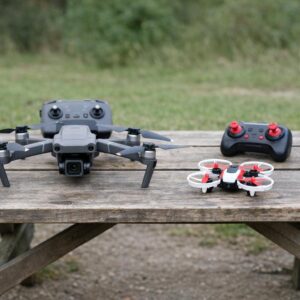
A toy drone can be useful for inexpensive indoor orientation practice, but it is not a mandatory step before buying a camera drone.
A simple aircraft without GNSS may teach:
- How yaw changes orientation
- Why left and right feel reversed when the aircraft faces the pilot
- How to use small control inputs
- How to maintain a low hover manually
- How to land on a chosen area
It may also be more difficult to control than a modern positioning-assisted camera drone. A light indoor aircraft can drift constantly, have a short battery life, and provide no useful camera result.
Choose a toy drone only when manual practice and inexpensive entertainment are the actual goals. Do not buy one solely because an article claims every beginner must complete a fixed number of training hours before touching a camera drone.
Small propellers can injure eyes or skin, catch long hair, frighten pets, and damage fragile objects. Clear the room, use appropriate guards, follow age guidance, and supervise children actively.
How to choose in five decisions
Decide whether you want the experience of flying, automated personal clips, travel video, still photography, property images, or a platform for future professional development.
Consider indoor rooms, calm parks, open countryside, cities, mountains, beaches, coastal wind, low light, and travel restrictions. Do not buy around one exceptional trip.
Choose between convenient stabilized video, a conventional three-axis camera, RAW photography, a larger one-inch sensor, or a dual-camera system.
Include the controller, phone compatibility, charger, batteries, microSD card, case, propellers, protection plan, registration, and editing equipment.
Check the aircraft’s exact weight, Remote ID status, intended use, registration requirement, local availability, warranty, and the rules for locations where it will actually be flown.
Controller choice can change the experience
Some bundles use a controller that connects to a compatible smartphone. Others include a controller with an integrated screen. The screened option can reduce setup time and avoid interruptions from phone calls, low phone storage, incompatible cables, or outdoor screen brightness.
A phone-based controller may cost less and allow the user to work with a familiar device. Before purchasing, check:
- Supported mobile operating system and minimum version
- Whether the phone appears on the manufacturer’s tested-device list
- Connector type and included cables
- Screen brightness in outdoor conditions
- Available storage for the application and cached media
- Phone overheating during long sessions
- Whether the desired controller is compatible with the exact drone
Controllers with similar names are not automatically interchangeable. Verify compatibility on the official product or support page.
Accessories: useful, optional, or unnecessary?
Extra battery
Useful for learning because setup and travel often take longer than one flight. It is not necessary to buy three batteries immediately when the buyer is still deciding whether the hobby will continue.
Charging hub
Convenient for managing several batteries, but many hubs charge sequentially rather than all batteries simultaneously. Read the exact charging specification.
Landing pad
Helpful around dust, dry grass, gravel, sand, mud, and uneven ground. It is less important when a clean, stable launch surface is already available.
Spare propellers
Worth keeping available. Use only the correct propeller type and installation method, and replace damaged blades in the manufacturer-specified pairs or sets.
Neutral-density filters
Useful for controlling video shutter speed in bright light or for intentional long exposures. They are not required for a beginner’s first ordinary photographs or practice flights.
Protection plan or insurance
May reduce repair risk, but coverage, deductibles, replacement limits, exclusions, activation deadlines, and regional availability should be reviewed carefully.
The real ownership cost
Avoid fixed two-year ownership estimates. The cost varies too much by aircraft, country, crash history, battery health, warranty, service availability, software, accessories, and resale conditions.
Drone, compatible controller or mobile device, suitable charger, correct application, battery, and any required registration or identification equipment.
Compatible storage, card reader, backup drive, editing device, software, and sufficient processing power for the selected codec and resolution.
Propellers, batteries, cables, filters, gimbal protection, cleaning supplies, carrying case, and possible repair or replacement fees.
Battery replacement should not be scheduled through one universal cycle number. Battery age, storage temperature, discharge depth, physical condition, cell balance, warnings, swelling, impact damage, and repeatable loss of performance all matter.
Buying used without inheriting someone else’s problem
A used drone can reduce the purchase cost, but beginners may find it difficult to identify hidden impact damage, account-binding problems, battery deterioration, incompatible accessories, or a damaged gimbal.
Before buying used, check:
- The exact aircraft and controller serial numbers
- Whether the previous owner has removed account or ownership binding where required
- Registration and Remote ID implications
- Arms, shell, motors, screws, antennas, landing structure, and vents
- Propeller condition and correct installation
- Gimbal startup, horizon, vibration, and camera focus
- Obstacle-sensor warnings
- Battery swelling, errors, age, and actual flight behavior
- Controller sticks, ports, screen, cables, and charging
- Availability of an original proof of purchase
- Whether the model still receives application and firmware support
Do not rely only on battery cycle count. A low-cycle battery can still be old, swollen, overheated, deeply discharged, or damaged in a crash.
United States rules beginners should consider before buying
- All recreational flyers must complete the free TRUST test and carry proof while flying.
- A recreational drone weighing 250 grams or more must be registered.
- A drone under 250 grams is generally exempt from registration only when flown exclusively under the limited recreational exception.
- Every drone operated under Part 107 must be registered, including an aircraft below 250 grams.
- Drones that are registered or required to be registered generally must comply with Remote ID unless an allowed alternative applies.
- Adding a battery, light, guard, module, or payload can change the ready-to-fly weight.
- Airspace authorization, visual line of sight, altitude, location rules, and safety requirements still apply to lightweight drones.
- Taking photographs or video for a business, property sale, client, employer, or another non-recreational purpose may require Part 107.
Models and categories beginners should approach carefully
Manual FPV and racing drones
Full manual or acro-mode FPV flight removes the automatic self-leveling behavior expected by many camera-drone beginners. It is a separate discipline that benefits from simulator practice, suitable instruction, protective equipment, legal flying locations, and a gradual progression.
FPV should not be described as impossible for a beginner, but a high-powered manual racing quad is rarely the simplest first aircraft for someone whose goal is ordinary aerial photography.
No-name products with unclear support
Brand size alone does not prove quality, and an unfamiliar manufacturer is not automatically unsafe. The concern is whether the buyer can verify:
- An official manual and complete specifications
- Battery and charger certifications
- Replacement propellers and batteries
- Application availability and privacy information
- Firmware and security updates
- Warranty and repair procedures
- Remote ID compliance when required
- Real downloadable photo and video samples
Discontinued drones sold as bargains
An older model may still fly well, but the application, battery inventory, phone compatibility, maps, repair service, firmware, accessories, or Remote ID status may no longer fit the buyer’s needs.
A discounted purchase is not good value when replacement batteries are unavailable or the required application does not work on the buyer’s phone.
Final pre-purchase checklist
- The intended use is clearly defined
- The exact regional model is available
- Current official specifications were reviewed
- Ready-to-fly weight was confirmed
- Registration requirements were checked
- Remote ID status was verified
- TRUST or Part 107 requirements are understood
- Camera samples were reviewed at full resolution
- RAW support was confirmed when needed
- Gimbal type was identified
- Obstacle-sensing coverage was understood
- Return-to-home behavior was reviewed
- Controller compatibility was confirmed
- Phone compatibility was checked
- Battery and charger options were reviewed
- Replacement batteries are available
- Replacement propellers are available
- Storage requirements were checked
- Repair and warranty terms were reviewed
- The complete bundle cost was calculated
- The aircraft suits the normal wind and terrain
- The user manual was downloaded
- A legal practice area was identified
- The purchase does not depend on one marketing number
Frequently asked questions
Is the DJI Mini 4 Pro still suitable for beginners?
Yes. Its lightweight standard configuration, three-axis camera, RAW photography, intelligent features, and omnidirectional sensing make it a capable compact option. Beginners must still learn the manual, route planning, Return to Home, wind limits, and sensor limitations.
Is the DJI Flip safer than the Mini 4 Pro?
The Flip’s full-coverage propeller guards provide useful physical protection around the propellers. The Mini 4 Pro provides broader omnidirectional visual sensing. These are different forms of assistance, and neither aircraft is crash-proof.
Should a complete beginner buy the Mini 5 Pro?
It can be appropriate for someone committed to high-quality photography and willing to learn on a valuable aircraft. A casual buyer may receive better value from a simpler model. Its actual ready-to-fly weight also deserves careful attention near the 250-gram threshold.
Is the Air 3S too advanced for a first drone?
Not necessarily, but it is larger, heavier, more expensive, and subject to registration in the United States. It makes more sense when the buyer already understands the intended photography or business use and accepts the additional cost and responsibility.
Do beginners need obstacle avoidance?
It is helpful but not mandatory. A beginner can practice safely in a large open area without nearby obstacles. When included, the system must be understood as a backup with limitations rather than a guarantee against collisions.
How many batteries should a beginner buy?
One battery is enough to learn whether the hobby is enjoyable, while two or three can make travel and structured practice more productive. Calculate charging time, bundle price, storage, and replacement cost before buying extras.
Are ND filters essential for a beginner?
No. They are useful for specific video shutter-speed goals and intentional long exposures. A beginner can learn safe flight, composition, exposure, and ordinary photography without purchasing filters immediately.
Does a drone under 250 grams require no paperwork?
In the United States, a purely recreational drone below 250 grams is generally exempt from registration, but the recreational pilot must still complete TRUST. Part 107 drones must be registered regardless of weight, and other airspace and operating rules continue to apply.
A sensible first drone is one that produces the result the buyer actually wants without creating unnecessary complexity. The Neo 2 emphasizes convenient personal filming, the Flip adds protected propellers and a conventional camera workflow, the Mini 4 Pro balances portability and advanced features, the Mini 5 Pro raises compact image quality, and the Air 3S provides a larger long-term platform.
Before purchasing, verify the exact regional model, current specification page, ready-to-fly weight, Remote ID status, warranty, controller compatibility, and complete bundle cost. A careful comparison before payment is less expensive than replacing the wrong drone after the first month.
Official references
- DJI — Neo 2 specifications
- DJI — Flip specifications
- DJI — Mini 4 Pro specifications
- DJI — Mini 5 Pro official support and specifications
- DJI — Air 3S specifications
- DJI — Consumer drone comparison
- FAA — Recreational flyer requirements
- FAA — The Recreational UAS Safety Test
- FAA — Drone registration requirements
- FAA — Remote Identification of drones
Dflyco Editorial Team creates practical, well-researched content about drones, aerial photography, flight safety, and responsible drone use. Our articles are reviewed using official documentation, manufacturer specifications, and trusted aviation sources to help readers make informed decisions.