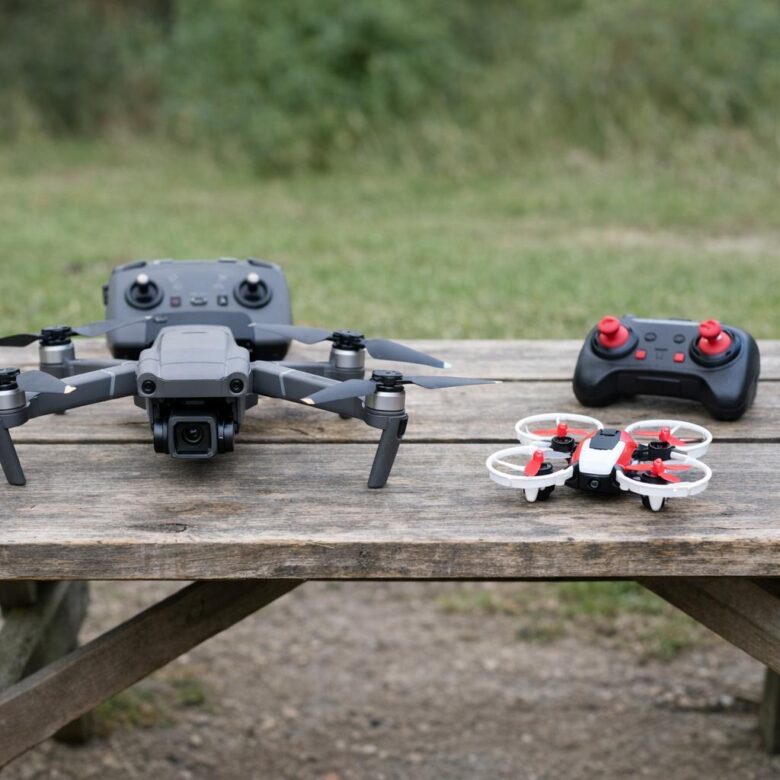
The difference between a camera drone and a toy drone is not determined by one feature, one price, or the presence of a small camera. The better choice depends on whether you want to enjoy basic flight, practice orientation, create usable photographs, record stable video, or build a system that can support longer-term projects.
Product listings often make the choice look simple: inexpensive drones are described as beginner toys, while more expensive models are presented as professional cameras. Real products do not fit into such clean categories.
Some compact camera drones weigh less than many toys. Some toy-style drones include basic GPS, optical positioning, or electronic stabilization. Some small camera drones are easy for beginners, while some inexpensive aircraft are difficult to control outdoors.
Instead of choosing by label, compare the complete aircraft: its control system, positioning, camera, stabilization, battery, repairability, safety features, documentation, and intended environment.
Best when image quality is not important and the main goal is learning orientation or enjoying short, closely supervised flights.
Useful when you want positioning assistance, a more stable camera, and a system that can produce shareable results without advanced production features.
Appropriate when camera controls, stable footage, reliable transmission, battery management, and consistent results matter more than the lowest purchase price.
A product sold as a toy can still be an aircraft under aviation rules. Weight, purpose of flight, registration status, equipment, airspace, and location matter more than the word printed on the box.
Think of drones as a spectrum, not two fixed categories
Usually designed around simple flight, low weight, short-distance control, inexpensive parts, and limited or no useful imaging capability.
May combine compact size with satellite positioning, return functions, a stabilized camera, application controls, and practical outdoor operation.
Prioritizes imaging, flight planning, transmission reliability, stronger camera controls, larger batteries, and more demanding professional or creative workflows.
This middle category is important. A beginner does not always need to choose between a disposable indoor toy and an expensive professional platform. A carefully selected starter camera drone may be easier to control than a cheap aircraft without positioning assistance.
What usually defines a toy drone
Toy drones are normally designed to make short recreational flight accessible at a low cost. Their design often prioritizes light weight, simple controls, replaceable propellers, and the ability to tolerate minor impacts.
Common characteristics may include:
- Small brushed or brushless motors
- Shorter flights and compact batteries
- USB charging or a simple included charger
- Basic altitude hold or no automated position hold
- Propeller guards for indoor use
- Fixed or manually tilted camera modules
- Direct Wi-Fi, Bluetooth, or short-range radio control
- Limited application support and fewer firmware updates
- Simple plastic construction and inexpensive replacement parts
These characteristics are common, not universal. A product marketed as a toy may include optical flow, a basic camera, automatic flips, headless mode, or a simple return function. Those features should not be confused with the more complete navigation and recovery systems used by many camera drones.
What a toy drone can teach
A simple drone can help a beginner practice throttle control, yaw, forward and backward movement, left and right movement, orientation, and gentle landing.
It can also teach an important lesson: when the front of the aircraft faces the pilot, left and right appear reversed from the pilot’s perspective.
However, a toy drone is not a required first step for every beginner. Someone who intends to fly a GPS-assisted camera drone can also learn safely through the exact aircraft’s beginner mode, flight simulator when available, open practice area, manual, and structured low-altitude exercises.
A drone without reliable position hold may require continuous correction. Outdoors, even a light breeze can move a small aircraft quickly. A more capable starter camera drone may feel calmer and more predictable to a new pilot.
What usually defines a camera drone
A camera drone is designed to produce images or video that remain useful after the flight. The camera system is supported by a more complete aircraft, controller, navigation system, application, battery system, and file-recording workflow.
Common features may include:
- Satellite positioning using one or more GNSS constellations
- A recorded home point and return-to-home function
- A mechanical gimbal or more advanced stabilization system
- Higher-resolution photo and video recording
- Manual or semi-manual camera controls
- Memory-card recording at a higher bitrate than the live feed
- Flight logs, maps, battery information, and warning messages
- Longer-range digital transmission systems
- Firmware updates and broader manufacturer documentation
- Optional batteries, filters, charging hubs, controllers, and accessories
Not every camera drone includes every feature. Some inexpensive models record high-resolution video but lack a three-axis gimbal. Some compact models use a fixed aperture. Some camera drones provide only forward obstacle sensing, while others provide broader coverage or none at all.
A product should therefore be judged by its exact specification sheet and manual, not by a retailer’s use of terms such as “professional,” “4K,” “GPS,” or “cinematic.”
The practical differences at a glance
| Area | Typical toy-drone approach | Typical camera-drone approach | What to verify |
|---|---|---|---|
| Primary purpose | Entertainment, orientation practice, and short flights | Photography, video, travel, documentation, or planned projects | Whether the product is designed around flying or around imaging |
| Positioning | Manual control, altitude hold, or basic optical positioning | GNSS, inertial sensors, barometer, and visual positioning working together | Whether it can hold horizontal position outdoors |
| Camera | Fixed module, low bitrate, limited control, or no camera | Stabilized camera with memory-card recording and exposure options | Actual sample files, not only the advertised resolution |
| Stabilization | None, basic electronic correction, or physical vibration isolation | Mechanical gimbal, electronic stabilization, or a combination | Number of stabilized axes and recording crop |
| Flight time | Often shorter, with small removable or built-in batteries | Usually longer, with intelligent battery information and warnings | Manufacturer test conditions and real replacement-battery cost |
| Transmission | Short-range radio or direct connection to a phone | Dedicated digital control and live-view system | Regional limits, obstruction performance, and controller type |
| Recovery features | May have no reliable return function | May include home-point return, low-battery logic, and signal-loss behavior | How the exact model behaves during signal loss |
| Repairs | Propellers and guards may be inexpensive, but electronics may not be economical to repair | Parts can be more expensive and some repairs require manufacturer service | Parts availability, warranty, care plans, and repair process |
| Learning | Can teach manual corrections and orientation | Can teach planning, camera operation, airspace checks, and controlled navigation | Which skills match the aircraft you ultimately intend to use |
Image quality involves more than the word “4K”
A retailer may advertise a toy drone as 4K even when the complete imaging system cannot produce detailed, stable footage comparable to a dedicated camera drone.
Useful image quality depends on several parts working together:
Sensor and lens
Sensor size, pixel design, lens quality, focus, field of view, aperture, processing, and lighting all influence the image. Resolution alone does not reveal noise, dynamic range, color, or detail.
Mechanical stabilization
A gimbal physically moves the camera to counter aircraft movement. It generally provides smoother footage than an unstabilized fixed camera, although wind, vibration, and aggressive control inputs can still affect the result.
Recording bitrate
A high pixel resolution combined with heavy compression can lose fine detail. Check the actual recording specification and full-resolution sample footage.
Exposure control
Manual exposure, white balance, RAW photography, color profiles, and histogram tools can make a camera more useful for editing and repeatable results.
The live image shown on a phone may also differ from the file recorded onboard. A weak or compressed live feed does not always represent the final recording, while some inexpensive drones record only the same limited feed that is transmitted to the phone.
Before buying for photography, look for original downloadable samples, independent full-resolution files, and clear documentation about stabilization and recording formats.
Flight stability and wind performance
A camera drone with reliable GNSS and visual positioning can normally maintain its location more effectively than a basic aircraft that depends on manual correction.
That does not mean it will remain perfectly motionless or that positioning can overcome unlimited wind. Wind, gusts, satellite reception, lighting, surface texture, calibration, sensor condition, and aircraft weight all affect stability.
The original article used fixed drift numbers for a toy drone and a specific camera drone in a 10 mph wind. Such numbers should not be treated as universal because the result depends on the exact aircraft, wind direction, gusts, altitude, positioning status, and test method.
Small toy drones are often better suited to calm indoor spaces than outdoor areas. A light aircraft can be moved rapidly by wind and may not have enough power, navigation, or transmission range to return reliably.
Even a small drone can injure eyes, cut skin, damage fragile objects, frighten pets, or become trapped in hair or curtains. Use propeller guards when appropriate, clear the room, keep faces and fingers away, and provide active adult supervision when children are involved.
Return to Home and obstacle sensing reduce risk, but do not remove it
Many camera drones can record a home point and follow a programmed response when the control signal is lost. Depending on the model and settings, the aircraft may return, hover, or land.
This behavior must be confirmed in the manual and configured before flight. A return function can still fail to protect the aircraft when:
- The home point was recorded incorrectly
- The selected return altitude intersects an obstacle
- The aircraft lacks enough battery for the return
- Wind prevents normal progress
- Positioning is unavailable or unreliable
- The route includes wires, branches, glass, or objects the sensors cannot detect
- The launch location has moved since takeoff
Toy drones may lack these recovery systems, but camera-drone automation should not create overconfidence. The pilot remains responsible for maintaining visual awareness and understanding the aircraft’s behavior.
Purchase price is only one part of ownership
Fixed price ranges quickly become outdated and do not describe regional taxes, sales, bundles, discontinued models, used equipment, or replacement-part availability.
Compare total ownership instead of relying on the price shown for the basic package.
Check flight time, charging time, replacement price, availability, storage requirements, and whether the battery is built in or removable.
Some drones require a compatible smartphone. Others include a screened controller that changes the total price and setup process.
Camera drones may require a compatible memory card, card reader, backup space, and a computer or phone capable of editing the files.
Review propellers, guards, motors, arms, gimbal parts, manufacturer service, warranty terms, and whether crash damage is covered.
A case, landing pad, charging hub, filters, spare cables, and propeller holders may be useful, but not every buyer needs them immediately.
Depending on the country and intended use, registration, testing, certification, authorization, insurance, or permits may be required.
Avoid universal ownership estimates such as assuming that every camera drone will cost a particular percentage of its price each year or retain a fixed resale value. Repair and resale depend heavily on the model, condition, market, battery health, support period, and timing.
Which type should you choose?
When the goal is simply flying, an inexpensive aircraft may be enough. When the photograph or video is the final product, prioritize the camera and stabilization system.
A protected indoor room, backyard, open field, travel destination, coastal area, and urban property create very different requirements.
Evaluate people, pets, windows, traffic, water, trees, property, and the cost of replacing the aircraft.
Check the controller, application, batteries, charging, memory cards, spare parts, manual, firmware support, and compatible devices.
Aircraft weight and intended use may affect registration, Remote ID, testing, certification, and where the drone can be flown.
A toy drone may be the better choice when:
- The main goal is short indoor entertainment
- Image quality is not important
- The flying area is small and controlled
- You want inexpensive orientation practice
- Replacement propellers and guards are readily available
- The product’s age guidance and supervision requirements are suitable
A camera drone may be the better choice when:
- You want stable outdoor photos or video
- Reliable position hold is important
- You need onboard recording rather than only a live phone feed
- You want return functions and detailed battery information
- You plan to edit, publish, document, or deliver the images
- You are prepared to learn the rules and maintain a more valuable aircraft
Buying a drone for a child
A drone should not be selected only by price or by the word “toy.” Review the manufacturer’s stated age range, warnings, battery access, charger, propeller protection, control difficulty, and required adult supervision.
Before flight
- Read the manual and age recommendation
- Install propeller guards when designed for the aircraft
- Remove pets and fragile objects
- Tie back long hair
- Choose a room with clear space
- Explain how to stop the motors
During charging
- Use the recommended charger
- Follow the stated charging time
- Charge on a suitable nonflammable surface
- Keep the battery away from combustible material
- Do not use a swollen or damaged battery
- Provide adult supervision
The U.S. Consumer Product Safety Commission advises following manufacturer instructions when charging rechargeable lithium batteries used in remote-controlled toys. It also recommends adult supervision, avoiding unattended charging, and stopping use after damage.
United States rules apply to both categories
Important points for recreational flyers
- All recreational flyers must complete the free TRUST safety test and carry proof while flying.
- A recreational drone weighing 250 grams or more must be registered with the FAA.
- A drone under 250 grams is not automatically exempt from airspace, visual-line-of-sight, safety, or local property rules.
- Drones that are required to be registered, or are registered, generally must comply with Remote ID unless an allowed alternative applies.
- A drone flown under Part 107 must be registered even when it weighs less than 250 grams.
- Taking photographs to help sell a property or service is an example of non-recreational activity.
- Recreational pilots must keep the drone within visual line of sight and yield to other aircraft.
The exact rules differ by country. Before buying, check the aviation authority for the location where the drone will be used. Also review park rules, property permission, privacy laws, protected areas, and local restrictions.
Specifications that deserve extra attention
Pre-purchase checklist
- Exact takeoff weight confirmed
- Intended indoor or outdoor use defined
- Original image samples reviewed
- Mechanical or electronic stabilization identified
- Onboard recording confirmed
- Memory-card requirements checked
- Positioning system understood
- Signal-loss behavior confirmed
- Return-to-home behavior reviewed
- Propeller guards available when needed
- Battery flight and charging times reviewed
- Replacement battery price checked
- Spare propellers available
- Controller type confirmed
- Phone compatibility checked
- Application reviews and support checked
- Warranty and repair process reviewed
- Age recommendation checked
- Registration and Remote ID requirements checked
- Current manufacturer manual downloaded
Common buying mistakes
- Assuming every beginner should start with a toy: a stable starter camera drone may be easier to control outdoors.
- Buying by resolution alone: an advertised 4K camera may still have weak stabilization, compression, or image quality.
- Ignoring wind: a very light drone without positioning can be difficult to recover outdoors.
- Confusing a return button with true navigation: some inexpensive “one-key return” functions do not use a recorded GNSS home point.
- Believing obstacle sensors prevent crashes: sensor coverage and detection have important limitations.
- Forgetting replacement parts: a low purchase price is less useful when batteries or propellers cannot be obtained.
- Assuming under 250 grams means no rules: many operating requirements still apply.
- Buying for a child without checking battery and age guidance: active adult supervision may still be necessary.
- Trusting a retailer’s flight-time claim without test conditions: usable endurance changes with wind, temperature, speed, and battery condition.
Frequently asked questions
Should every beginner buy a toy drone first?
No. A toy drone can provide inexpensive orientation practice, but it is not required. A beginner can also learn with a stable camera drone by reading the manual, using beginner settings, practicing in a clear legal area, and starting with simple low-altitude movements.
Can a toy drone take good photographs?
Some can create acceptable casual images in bright light, especially for viewing on a phone. Buyers should review original files because advertised resolution does not reveal stabilization, compression, dynamic range, or detail.
Is a small toy drone automatically safe indoors?
No. Small propellers can still injure eyes or skin and can damage objects. Clear the room, use suitable guards, keep people and pets away from the propellers, and supervise children actively.
Does a drone under 250 grams require TRUST?
In the United States, recreational flyers must complete TRUST regardless of whether the drone is below the recreational registration threshold.
Does a camera drone always require registration?
The category name does not determine registration. In the United States, recreational drones weighing 250 grams or more must be registered. Drones operated under Part 107 must be registered regardless of whether they weigh less than 250 grams.
Is a camera drone suitable for indoor flight?
Some compact camera drones have indoor positioning or propeller guards, but indoor flight still requires sufficient space, lighting, sensor awareness, and control. Larger or more powerful models may be unsuitable for an ordinary room.
Which option is better for social media?
A camera drone is generally more suitable when stable, editable images are important. A toy drone may be enough when the goal is simply sharing a casual record of the flying experience rather than producing polished aerial footage.
A toy drone is a reasonable choice when the experience of flying matters more than the resulting image. A camera drone is a better choice when the photograph, video, navigation system, or reliability is the reason for owning the aircraft.
The most practical purchase is not necessarily the cheapest or most advanced model. It is the aircraft whose camera, controls, battery, safety features, rules, and repair costs match the way it will actually be used.
Official references
- FAA — Recreational Flyers and Community-Based Organizations
- FAA — The Recreational UAS Safety Test
- FAA — Remote Identification of Drones
- FAA — Getting Started with Drones
- U.S. Consumer Product Safety Commission — Toy Safety Guidance
- U.S. Consumer Product Safety Commission — Rechargeable Battery Charging Safety
Dflyco Editorial Team creates practical, well-researched content about drones, aerial photography, flight safety, and responsible drone use. Our articles are reviewed using official documentation, manufacturer specifications, and trusted aviation sources to help readers make informed decisions.